✴️INTRODUCTION to an EXTREME SIMPLIFICATION of what a human being is, and of the system within which they evolve.
The Entity E⁰.
Nothing exists outside of the Entity E⁰.
Everything is contained within the memory and imagination of the Entity E⁰.
The container is termed the « Existent, » and the content is termed « Images. »
There is only ONE container.
Its imagination conceives and constructs images—a system referred to as the « Imaginary. »
A human being does not exist in the same way the Entity exists.
A human being is an image that belongs to the « Imaginary » of the Existent: the Entity E⁰.
All images—past, present, or future, including human beings—are stored within the memory of E⁰.
Outside of the Entity E⁰, NOTHING exists other than images.
The precise answer to the question—why and how does a human being exist?—is therefore:
In truth, a human being does not exist. They are merely a mental image conceived and constructed by the imagination of the Entity E⁰.
Though a human being may search eternally for a universal explanation (one that provides exact answers to every question they pose), they will inevitably return to this same conclusion:
They are nothing more than an image evolving within an « Imaginary History »—a history born from the imagination of the Entity E⁰, capable of infinite modification according to that same imagination.
Beyond merely understanding these concepts, it is essential to integrate them—through reading or listening—into the very mechanisms of how we function. They must be absorbed at least once in order to be committed to memory. It is from the point of this memorization that their work begins, leading—at varying speeds—to the correction and adjustment of our flawed mechanisms.
Without this memorization, one should neither hope for nor expect any such corrections or readjustments—and, consequently, no resolution to our psychological problems.
Seeking any other system for resolving psychological problems is futile and pointless, for the simple reason that any such system would not be linked to our Natural System.
Human beings are part of a grand configuration known as « History. » Their presence and their perfect functioning are essential to the success of this configuration.
Isolating psychological problems from their natural environment runs counter to natural logic, which is rooted in coherence and stability.
« Making psychological problems disappear » inevitably requires reconnecting them to the Natural System—to its logic, its principles, and its way of functioning.
And for this, it is necessary to understand the Natural System in its entirety , as a whole.
Through this summary, we are able to gain an overall perspective on our developmental situation within the system.
To perceive it more precisely, one must read the books of the Yparcho system.
This summary allows us to discern the difference between:
– what we are by nature
and
– what we think we are.
It also enables us to see the difference between:
– what we ought to do, by nature, to correct ourselves
and
– what we actually do.
Our reality is, in fact, quite different from the reality of the Natural System; this discrepancy triggers a coercive reaction from the Natural System toward us—a reaction that serves to distance us from our psychological problems, relegating them to the background.
Akileas Servos.
✴️Part 1. AN EXTREME SIMPLIFICATION OF WHAT A HUMAN BEING IS, AND OF THE SYSTEM WITHIN WHICH THEY EVOLVE.
The Yparcho system divides our humanity—the collective of all human beings—into two groups:
– The first group consists of those who feel neither the need nor the necessity to know the reasons for their existence and their presence within our System. They have no need or necessity to perceive, understand, or know with precision.
– The second group consists of those who do feel the need or the necessity to know the reasons for their existence and their presence within the System. They have a need or necessity to perceive, understand, and know with precision.
Perceiving, understanding, and knowing with precision are essential for completing the activation of the mechanisms that govern how one functions.
For a « machine-suit » (such as a human being) to function perfectly, all of its operational mechanisms must be activated.
This activation occurs through the absorption of specific, necessary information that originates outside of the machine-suit itself.
Therefore, having an exact understanding of how our Natural System functions is intrinsically linked to the perfect operation of the mechanisms within these machine-suits.
To speak of a human being deriving « satisfaction » from possessing exact knowledge is an unnatural concept.
Because the logic and principles that govern the Natural System are complex and difficult to grasp, it is necessary to simplify them to the greatest possible extent.
✴️Part 2. EXTREME SIMPLIFICATION OF WHAT A HUMAN BEING IS AND OF THE SYSTEM IN WHICH THEY OPERATE.
Only the entity E⁰ exists and is present.
Nothing else exists, and nothing else is present.
The entity E⁰ consists primarily of memory and imagination.
IMAGINATION is the propensity to create IMAGES that do not exist and are not present anywhere other than within the imaginary realm of the entity E⁰.
Only the entity E⁰, its memory, and its imagination exist.
The following terms must be noted:
– memory
– imagination
– images
– imaginary realm.
When the entity E⁰ conceives and constructs Stories for its own reasons, it does so using its Memory and Imagination.
Conversely, the memory and imagination of the entity E⁰ serve to conceive, construct, and preserve Stories.
Stories consist of an infinite succession of images created by the imagination of the entity E⁰.
Imagination and images constitute the imaginary realm of the entity E⁰.
A story is invariably composed of:
– a framework that takes the name of Logic and Principles;
– a scenario, or the unfolding of the Story;
– elements of the unfolding process called components or Characters;
– roles to be played in the unfolding of the Story, which are assigned to the elements; at that point, these elements take the name of Characters.
The human being must then be defined through two sets of questions:
1st set *
What is a human being? Or, why are human beings present, and do they exist?
The human being is an imaginary character, born of the imagination of the entity E⁰ and destined to play a role in History.
Human beings do not exist and are present nowhere other than in the imagination of the entity E⁰.
2nd group *
How are human beings present, and do they exist?
Human beings exist in relation to their role in History—a role that is useful and necessary to History.
The modalities of the unfolding of History constitute the Yparcho system.
The Yparcho system is a system for explaining History as it unfolds, and it proves to be highly complex.
The importance of the human being’s role in History warrants close attention:
When a human being effectively fulfills their role in History, they are reused.
Akileas Servos.
✴️Part 3. EXTREME SIMPLIFICATION OF WHAT A HUMAN BEING IS AND OF THE SYSTEM IN WHICH THEY EVOLVE.
Diagrams of the symbolized elements forming our System of Evolution, which consists of the Entity E⁰ and its Imaginary History, within which we evolve.
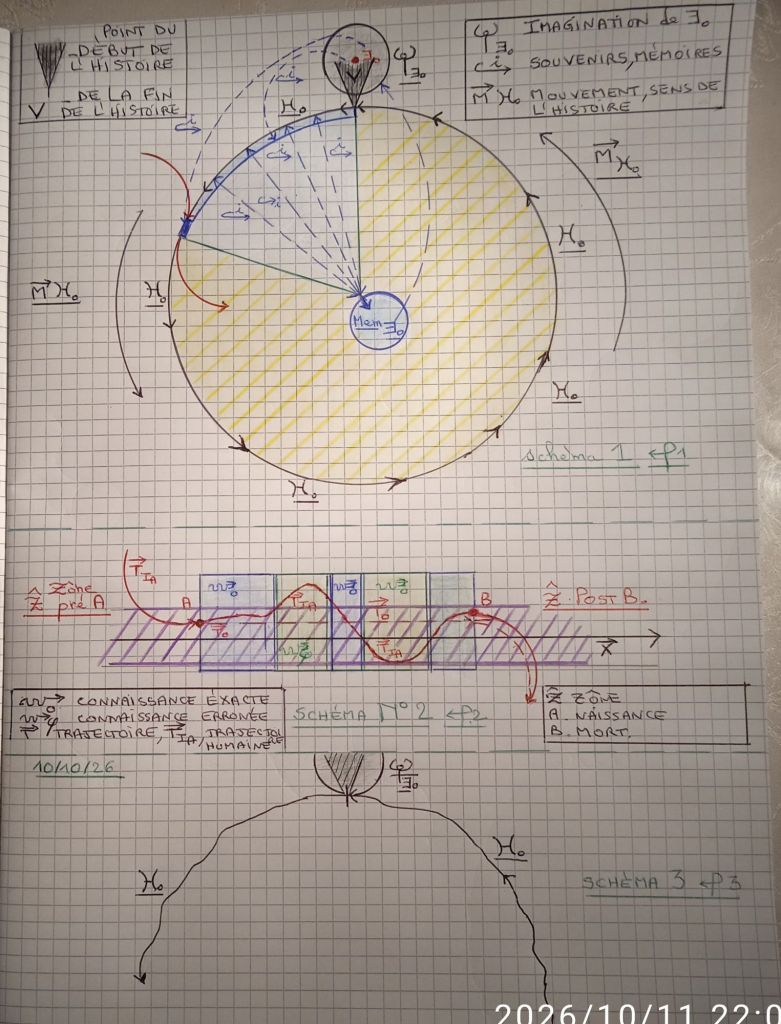
E⁰: entity that is the sole Existing and Present Element, also symbolized by the unit 1 (union, unique).
ΨE⁰: imagination of E⁰.
V: starting point and end point of the History.
H⁰: the History conceived and constructed by the imagination of the Entity E⁰.
M—>H⁰ movement or direction of the History: beginning, unfolding, end.
C—>i recollection, memories.
W–>º: accurate knowledge.
W–>φ: erroneous knowledge.
To: perfect trajectory of the human being.
Tiª: trajectory of the human being.
Z pre A: zone where the human being is located before their introduction into the system (before birth).
Z Post B: zone where the human being is located after their withdrawal from the system (after its dismantling, after death).
EXPLANATIONS:
RECAP of the elements composing the framework in which we evolve.
The Entity E⁰—the sole Existing and Present entity—constructs, through its imagination, an Imaginary History composed of Images. Human beings, among other elements, are merely images born of the imagination of E⁰ and constitute a small part of History.
History should be viewed as a train.
This train travels in a loop (the H⁰ circle), starting at a departure point and moving ceaselessly until it reaches its destination.
The train’s role and function is to transport all the elements that make up History from one point to another:
– past points represent the memories that build History.
– future points—which do not yet exist—build the continuation of History.
Elements of History, such as human beings, board the train as it moves ceaselessly; this boarding corresponds to a human being’s birth.
Then, they disembark from the moving train; this departure corresponds to a human being’s death.
The role and function of human beings during their journey (their « AB Journey ») is:
– to absorb memories—elements originating in the Future that human beings transform into the Present.
– to store these memories (the Future transformed into the Present) as elements known as the « Past, » by committing them to memory.
– to leave them behind on the train when we disembark.
These elements of the Past—or memories—form the traces of History, preventing it from fading from the memory of the entity E⁰; thus, History, which is inherently volatile, endures and becomes fixed.
Human beings exist through their functions, which are:
perceiving the elements that constitute History —–> storing these elements in their memory —–> surrendering these elements—essential to the construction of History—upon disembarking from the train. For this to happen, stored memories must be perfect and accurate.
To achieve this, human beings must function perfectly.
For that, human beings must be perfectly calibrated.
HISTORY is a train that never stops; it constantly picks up passengers who have specific functions and lets them off—an ongoing process.
We are passengers on the train.
Explanation of diagrams No. 2 and No. 3.
X—> represents the force of expansion, which also serves as the model for the trajectory followed by human beings.
When human beings board the train, they must adhere to a trajectory that is in sync with the expansion force X—>.
w—>⁰ accurate knowledge.
w—>φ erroneous knowledge.
T—>Iª trajectory of human beings.
T—>⁰ perfect trajectory of human beings.
The trajectories form the outline of the circle.
Point A: the point where human beings enter the system. This is birth.
Point B: the point where human beings leave the system. This is death.
They achieve this by perceiving accurate knowledge in the form of information that perfectly fuels their movements and actions.
Accurate knowledge corresponds to the perfect information transmitted to them by entity E⁰.
Transmitted information that is misperceived by human beings constitutes erroneous knowledge.
This erroneous knowledge is the cause of the imperfect trajectory taken by human beings, and consequently, of the imperfect execution—or non-execution—of their functions. Erroneous knowledge has the effect of diverting the trajectory of human beings.
This deviation has the effect of slightly distorting the course of history. (Here, the course takes the symbolic form of a circle.)Distortions in the circular path prevent a perfect junction between the circle’s two ends—a junction that corresponds to the end of History.
Human beings board the train to give lasting substance to the train’s movement:
– this materialization occurs through memories.
– this materialization of the train’s movement renders the history perceptible to the entity E⁰.
✴️Part 4. EXTREME SIMPLIFICATION OF WHAT A HUMAN BEING IS, AND OF THE SYSTEM WITHIN WHICH THEY EVOLVE.
FRAMING THE PROBLEM:
Within the set of complex mechanisms that make up our Natural System, the human being is an « ultra-sophisticated » complex mechanism.
HIGH-LEVEL HYPOTHESIS (H.h.):
The human being is a prototype, and their evolution represents an experimental study aimed at improving their design and construction.
From the perspective of the Natural System, this prototype appears unsatisfactory in relation to the desired objectives.
[“Perfect” and “imperfect” are terms reserved for the pleasant notion of specifications, conditions, and constraints.]
The human being should be viewed as an attempt by the Natural System to design and construct a complex mechanism that is both autonomous in its evolution—throughout the unfolding of history—and, simultaneously, capable of being steered and actively controlled. This would render it a hybrid complex mechanism.
In this respect, it differs from other complex mechanisms by the way it evolves throughout history.
When pursued, this hypothesis helps to explain certain human behaviors that appear to contradict logic and natural principles.


Votre commentaire