💠Ⓜ️6️⃣ fr.note 6. Psychology.
Return to note #1.
All human beings are exclusively at the service of the Natural System, to the exclusion of any other recipient, including themselves.
When they deviate from this course of action, the Natural System corrects them until they return to their natural (perfect) trajectory.
The Regulator is at the service of the Natural System, and all its actions (adjusting deviating human beings) are intended to succeed for the benefit of the Natural System. The Regulator is naturally bound to successfully perform its function:
the Natural System will signal its failures.
In the natural situation: whatever the degree of evolution of human beings during their journey (AB), all their actions are subject to and obey the logic and principles of the Natural System.
The meaning of these actions is invariably singular:
Actions of the combining machines —> for the Natural System.
Therefore, the Regulator NEVER acts in favor of disordered human beings nor does it act under the orders of disordered human beings.
💠Ⓜ️7️⃣ fr.note 7 . psychology.
Regarding the classification made by the Regulators concerning « unregulated » human beings. Use of the comprehension mechanism to create a classification.
Upon the initial encounter with an unregulated human being, the Regulator must determine the individual’s status.
The Yparcho System designates the Regulator as KKIª, the unregulated human being as Iªλ, and the regulated human being as Iª.
Classification falls into two categories based on the functioning of the comprehension mechanism:
– Iªλ: when the comprehension mechanism is inactive or malfunctioning. This is category Iªλ or kIªλ.
– Iª: when the comprehension mechanism functions perfectly. This is category Iª or kIª.
Each category requires a specific adjustment method.
Read the article from Book 3: 3-45.a154.
The Iª (or kIª) type is only slightly unregulated at the surface level: their comprehension mechanism is active and functioning perfectly; they are not the KKIª’s priority, as the Iª type will adjust quickly.
The Iªλ type requires a more complex adjustment process.
They are the KKIª’s priority.
Adjusting an Iªλ individual involves activating—or restoring the function of—their comprehension mechanism, which is currently inactive or malfunctioning.
Read the article from Book 3: L3-45.a154.
💠Ⓜ️8️⃣. fr.note 8 . psychology.
Application of Article 3-45.a154 of Book 3 to the function of the Regulators.
Fundamental principle that Regulators must strictly obey:
At no time do Regulators prioritize the « unnatural solicitations » of the combination-machines (for example, ideas of happiness or well-being are distressing ideas because they are unnatural).
Regulators respond to the solicitations of combination-machines only when those solicitations respect and follow
natural logic and principles:
such solicitations are termed « natural. »
For Regulators, there is only one single natural sequence:
The natural system issues the command —> the Regulator follows this command, which consists of correcting and adjusting human beings —> the Regulator applies corrections and adjustments to the maladjusted human being, without the combination-machine needing to solicit the Regulator.
The natural function of the Regulator is to correct deviations in the trajectories of human beings.
The Regulator must quickly discern the operation of the comprehension mechanism of the combination-machine facing them.
Either the comprehension mechanism is functioning perfectly,
or the comprehension mechanism is malfunctioning.
In the latter case, the Regulator determines the cause of the malfunction in one or more of the mechanisms constituting comprehension.
The operational state of the comprehension mechanism always reveals a distortion of the logic and principles employed by the maladjusted machine—a distortion arising from the comparison with natural logic and principles.
The results obtained from this comparison will allow for a highly precise approach to the corrections and adjustments required for the maladjusted human being.
💠Ⓜ️9️⃣ fr.note 9.psychology. Manual for the Reintroduction and Reconstruction—within the human being—of a system for readapting to the logic and principles of the Natural System. Intended for professionals specializing in the calibration of human functioning.
A reminder of a natural principle:
All calibrations of « machine-suits » (of which human beings are a type) remain under the authority of the Natural System, which bears sole, exclusive, and total responsibility for them.
This manual provides an overview of the situation in which human beings currently operate.
We find ourselves in a situation where human beings are beginning to harbor two coexisting systems within themselves (for instance, under the influence of « Calibrators »):
– the Natural System, and
– the anthropocentric system.
The Natural System has all but vanished, and lasting malfunctions are beginning to emerge.
The anthropocentric system is dominant.
A fundamental imbalance (affecting the Natural System) is beginning to take hold, forcing the Natural System to react.
Furthermore,
given the magnitude of the psychological issues present within them—issues that transform their « Journey (AB) » into an ordeal of extreme hardship—it is imperative for the individual concerned to return to the Natural System (and its logic and principles) and, simultaneously, to return to an enjoyable « Journey, » if they wish to avoid stepping outside their « tolerance cone » (reminder: see theoretical articles—as exiting the Natural System is irreversible). While knowing this is one issue to be addressed, putting it into practice constitutes another, requiring specific knowledge and methods. Human beings must be constantly « adjusted »—whether by themselves or with the help of others (such as « Adjusters »).
Human beings must be constantly « adjusted »—whether by themselves or with the help of others (such as « Adjusters »).
This is not currently the case.
The responsible Natural System is currently reacting to the situation: it compels human beings to undergo these adjustments.
Its adjustment methods are coercive and effective, as they are bound to achieve positive results.
💠Ⓜ️🔟 fr.note 10.psychology. Highlighting the interdependence of human beings with their host system or environment.
Diagram of the actual trajectory of human beings within the Natural System.
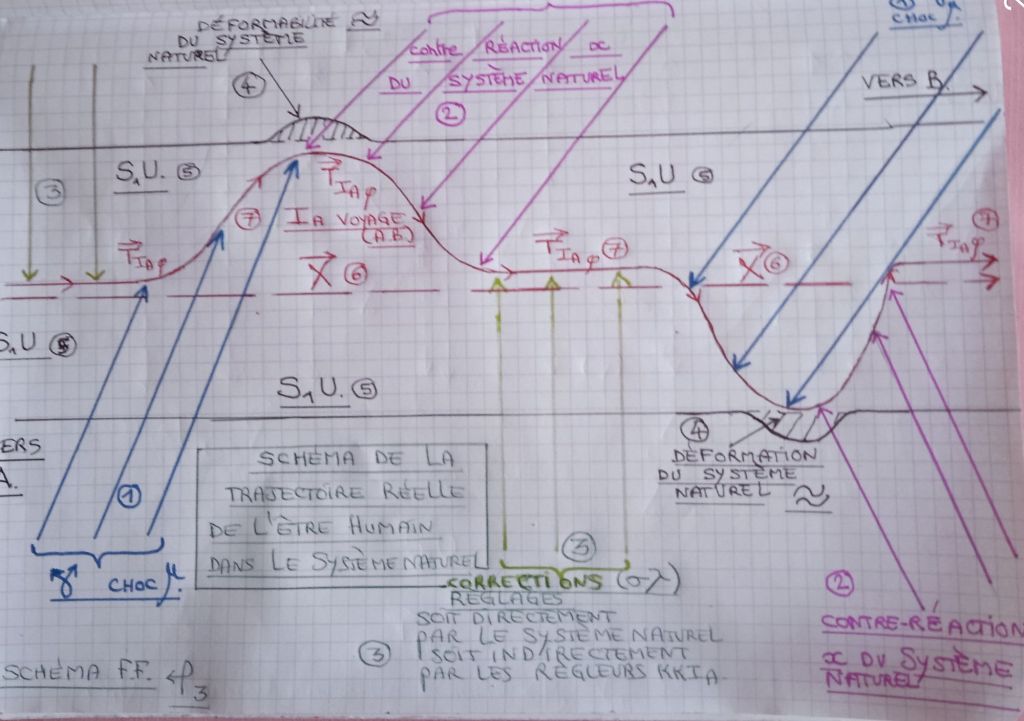
Schéma de la trajectoire réelle de l’être humain dans le Système Naturel.Diagram of the actual trajectory of the human being in the Natural System.
DIAGRAM LEGEND:
(1) Alien disturbances causing the shock penetrate the Natural System and reach human beings, disrupting their balance. These disruptions will affect the Natural System, which will in turn become deformed.
(2) A reaction of the Natural System, called reaction x, will act on the human being and their deviated Trajectory, restoring it to a perfect Trajectory through a series of corrections and adjustments (3) produced by the Natural System and exerted either directly by it or indirectly through the actions of the Regulators.
(4) Deformation of the Natural System after the impact on the human being.
(5) Symbolic limits of the Natural System.
(6) Representation of the Force of Expansion X, which guides all trajectories within the Natural System.
(7) Deformed trajectory of the human being after the impact.
This diagram, therefore, highlights:
1- The natural interdependence of the Natural System with all its elements.
It is necessary to consider the complete lack of freedom of action for all combination-machines, which will encounter other combination-machines, each carrying an objective to achieve and an obligation to succeed, for the benefit of the Natural System.
2- The compelling idea of the imprint, for all elements of the Natural System: the imprint of their existence that they leave on their environment. (Consider, for example, the imprint a human being can leave when falling in the snow.)
When the machine-combination malfunctions, it will leave in its environment the imprint of a malfunctioning, deformed element.


Votre commentaire